Start an exciting journey through Ancient Rome’s grandeur. Here, Roman architects and engineers left a lasting impact on Western civilization. See the iconic structures like the Colosseum and the Pantheon. Learn about the rich cultural heritage that still inspires us today.
Ancient Rome’s architecture has always amazed and impressed people. These structures, built with great skill and vision, show the creativity of their makers. They are symbols of the Roman Empire’s cultural and historical importance.
The Eternal City: An Introduction to Ancient Roman Architecture
Rome, the “Eternal City,” sits on the Italian peninsula’s hills. It shows off ancient architecture’s greatness. The city’s landmarks and urban design highlight the Romans’ skill and culture.
The architecture of ancient Rome mirrors its wide reach and cultural diversity. Buildings and spaces show off the classical look with columns, arches, and domes. These features were both beautiful and useful, showing the Romans’ smart solutions.
Roman architecture also focused on city planning and infrastructure. The city had roads, aqueducts, and baths that connected it well. This showed the Romans’ aim to build a powerful and efficient city.
Today, visitors to Rome can explore its ancient architecture. They can see the Colosseum’s arches and the Pantheon’s dome. These sights tell us about the Romans’ creativity and lasting impact.
The Colosseum: A Marvel of Roman Engineering
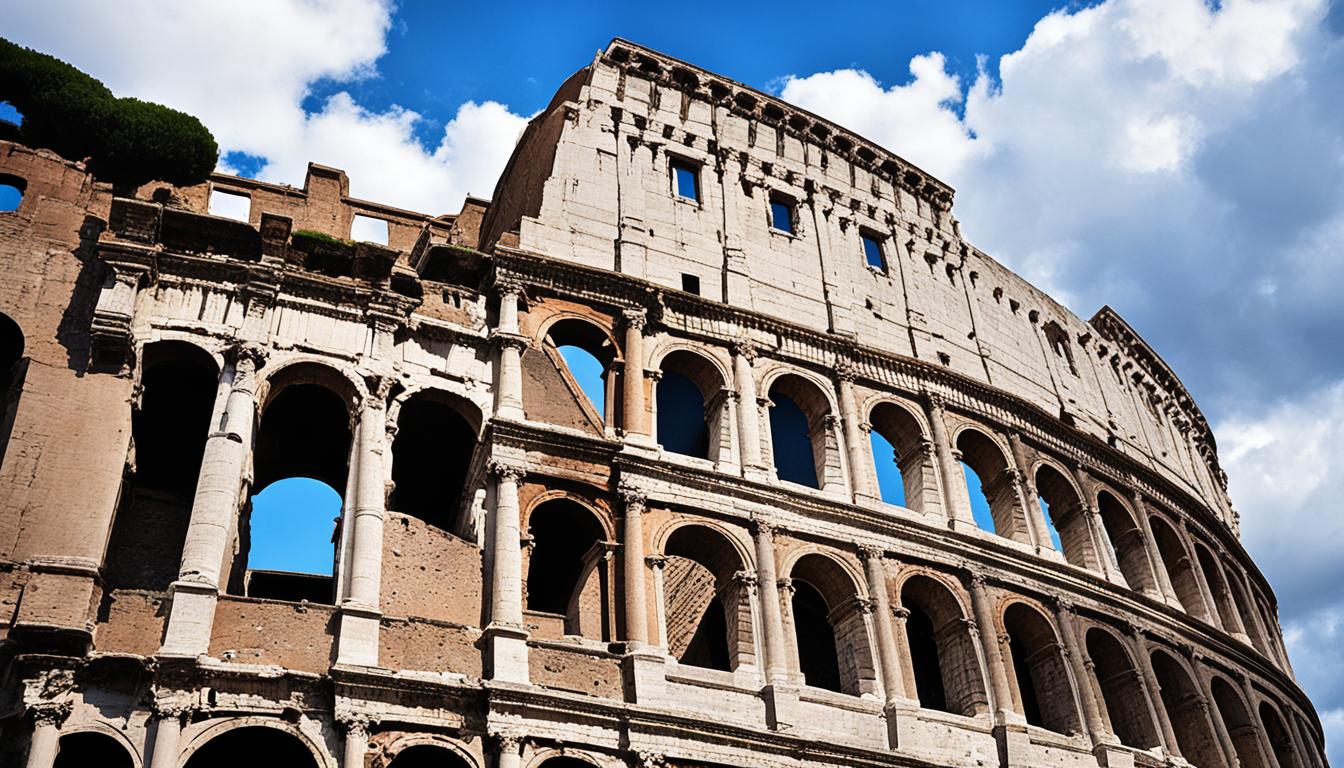
The Colosseum is a symbol of ancient Roman skill and greatness. It draws visitors from all over with its stunning design and deep history. Built in the 1st century AD, it shows the amazing engineering skills of the Romans. They built a structure that has lasted for centuries.
Design and Construction Techniques
The Colosseum’s design was groundbreaking, using cutting-edge construction methods. It was built as a huge, multi-level amphitheater for gladiatorial events. The Romans used concrete, stone, and brick, along with arches and vaults. This made a strong and beautiful amphitheater that could hold thousands of people.
Underneath the Colosseum, there were special chambers called the hypogeum. These had pulleys, lifts, and trap doors to bring animals and gladiators into the arena. This setup made the events in the arena smooth and exciting for the audience.
Historical Significance and Legacy
The Colosseum is more than just a beautiful building. It was the site of famous and brutal gladiatorial events in ancient Rome. These events, with their battles and public executions, were key to Roman culture and society.
Now, the Colosseum is a symbol of Roman power and creativity. It attracts millions of visitors every year. As a UNESCO World Heritage Site, it continues to inspire people worldwide. It shows the incredible achievements of ancient Roman engineering and design.
The Pantheon: A Testament to Roman Ingenuity
In the heart of Rome, the Pantheon shows off ancient Roman skill in building. This famous spot has amazed people for years. It’s a symbol of the Romans’ unmatched building skills.

The Pantheon’s dome is a big deal in architecture. It was made with new methods back then. The way it looks and works together is amazing. It shows how the Romans were creative in building.
Looking into the Pantheon’s past, we see a lot of hard work and a drive for perfection. The design is perfect, with columns, arches, and domes working together well. This shows how the Romans knew a lot about building strong structures.
The Pantheon has left a big mark on architecture. Its dome and design have inspired many architects. It’s a key example of Roman innovation in building.
The Roman Forum: The Heart of Ancient Roman Civilization
The Roman Forum is in the heart of Rome, showing off ancient Roman greatness. It was a key spot for politics, religion, and social life. Now, it’s a place where we can see what life was like back then.
Walking through the Roman Forum feels like going back in time. You can imagine the market’s buzz, the crowds at debates, and the sounds of religious events. Every old column and arch has a story, showing us the history of the Roman Empire.
Uncovering the Architectural Wonders
The Roman Forum has many amazing buildings, each with its own tale. You’ll see the big columns of the Temple of Saturn and the Arch of Titus. These landmarks show off the Romans’ skill in building and their cultural impact.
The way the Forum is laid out tells us about the city’s planning and growth. Walking through, you feel like you’re part of Roman life. You’ll see where people shopped and where they prayed, giving you a peek into their daily world.
The Roman Forum is very important culturally. It was the heart of ancient Rome, seeing empires rise and fall, and people’s big moments. Thanks to archaeologists and preservation, it still teaches us about history, connecting us to the past.
Cultural Wonders: Ancient Roman Baths and Aqueducts
Ancient Rome was a civilization that left a lasting impact on the world. Its public infrastructure, like the Roman baths and aqueducts, shows this best. These structures were not just useful; they were cultural marvels that highlighted Roman ingenuity.
The Roman baths were more than places for getting clean. They were social spots where people could meet, unwind, and do various activities. These baths were built with great care, featuring beautiful designs and smart engineering. They made sure bathers had a comfortable and luxurious time.
The Roman aqueducts were engineering wonders that brought fresh water from far away to the city. These structures were built with great precision and skill. They were key to supporting the city’s growing population and helping with the development of public spaces like baths.
The Romans worked hard to create top-notch public spaces. This effort made life better for their citizens and helped shape the city’s culture and society. Today, these engineering feats still amaze visitors and scholars. They show the creativity and resourcefulness of this amazing civilization.
The Appian Way: A Journey Through Roman History
The Appian Way stretches across Italy, showing off ancient Roman engineering and culture. Known as the “Queen of Roads,” it linked Rome to the empire. It left a big mark on history and architecture.
Architectural Marvels Along the Ancient Road
Walking the Appian Way, you’ll see amazing landmarks. You’ll find grand monuments, tombs, and mausoleums. Each one tells a story of Rome’s rich culture.
Imagine the busy streets of old Rome as you look at the ruins. It feels like stepping back in time to the Roman era.

The Appian Way is full of ancient Roman aqueducts. These amazing structures brought water from far away to Rome. They show the Romans’ smart way of managing resources and building infrastructure.
As you walk, you’ll see the tall arches and detailed masonry of these aqueducts. They impress everyone who sees them.
The Appian Way also has many funerary monuments. These show how much the Romans respected their dead. You’ll see beautiful sarcophagi and tombs that tell us about their beliefs and social structure.
By visiting these sites, you learn more about the Appian Way’s importance. You understand its role in shaping the Roman Empire.
The Palatine Hill: Exploring the Birthplace of Rome
Visit the Palatine Hill, the legendary spot where Rome began. Here, you’ll find archaeological sites and ruins that tell the story of Ancient Rome. They show us the roots of the Roman civilization and its lasting cultural impact.
The Palatine Hill is key to Rome’s history. It’s where Romulus and Remus, the city’s founders, were found and raised by a wolf. This story gives the hill deep historical importance. It was a key spot for Roman emperors and a center of power.
Walking through the Palatine Hill, you’ll see the remains of grand palaces and temples. These ruins connect us to the Roman Empire’s glory days. They let us feel the rich culture that made Rome famous worldwide.
The hill also offers stunning views of the city. You can see the Colosseum and the Roman Forum from here. These sights remind us of the Palatine Hill’s lasting impact. It’s a symbol of Rome’s spirit and its role in history.
Preserving the Past: Conservation Efforts and Challenges
The ancient Roman monuments across the Eternal City show the skill and greatness of a bygone era. Yet, time, weather, and human actions have damaged these architectural gems. Luckily, experts are working hard to keep the cultural heritage of ancient Rome safe with new conservation methods.
The Role of Modern Technology
Modern tech has become a key partner in saving ancient Roman monuments. Tools like laser scanning and photogrammetry create detailed maps of these sites. This helps with fixing and protecting them. Also, new repair methods, including 3D printing and special materials, are used to mend and strengthen these iconic buildings.
Modern tech has changed how we save historic sites. Digital databases and virtual models help experts study and fix these monuments. They can spot problems and plan fixes. Plus, new monitoring systems watch over things like humidity and temperature to keep these sites safe.
Thanks to modern tech, saving ancient Roman monuments is now better, more precise, and successful. These efforts show how dedicated professionals value these ancient sites. They know how important they are for understanding our history.
Rediscovering the Grandeur: Walking Tours and Immersive Experiences
Start an exciting journey to see the wonders of Ancient Rome with walking tours and immersive experiences. You’ll see famous landmarks and hidden treasures of the Eternal City. Experts will guide you, making history come alive. These experiences let you connect with ancient Roman culture in a unique way.
Walk on cobblestone paths in the Roman Forum, following in the steps of ancient people. See the ruins and monuments that were the heart of the Roman Empire. Learn about the Colosseum, a place where people gathered for centuries. Discover the Pantheon, a symbol of Roman skill, and its amazing construction.
These tours also show you Rome’s hidden spots, like the Appian Way and the Palatine Hill. You’ll see the beauty of Roman baths and aqueducts. Every step of the way, you’ll grow closer to understanding and loving the culture that draws people worldwide.