The Pyramids of Giza have amazed people for centuries. These iconic structures are not just architectural marvels but also full of mysteries. They sit on the Giza Plateau and have captured the hearts of scholars, historians, and adventurers.
The Pyramids are famous for their precise engineering and mysterious purpose. They inspire us to keep exploring the ancient Egyptian legacy.
The Pyramids of Giza show the ancient Egyptians’ ingenuity and skill. These huge structures were meant to be the final homes for pharaohs. They have always sparked curiosity and theories.
Exploring the Pyramids reveals their architectural brilliance and deep cultural and religious significance. They symbolized the pharaohs’ power and the afterlife. The Pyramids also show the ancient Egyptians’ knowledge of astronomy.
What are the Pyramids of Giza?
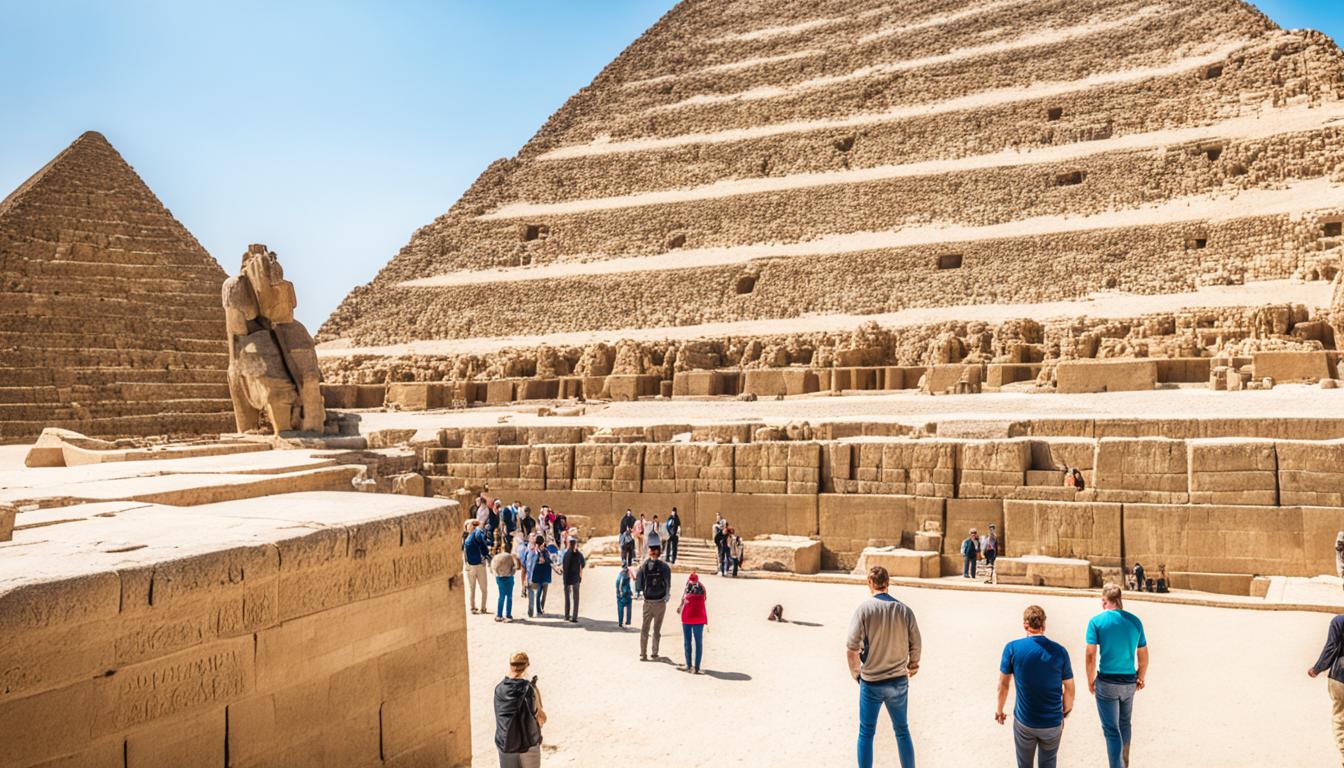
The Pyramids of Giza are located on the Giza Plateau near Cairo, Egypt. They are among the most amazing ancient Egyptian monuments. These huge structures were made as grand tombs for the pharaohs who ruled long ago.
The Ancient Egyptian Monuments
The Giza Plateau has three famous pyramids – the Great Pyramid of Khufu, the Pyramid of Khafre, and the Pyramid of Menkaure. These huge buildings, along with the mysterious Sphinx, have amazed people for centuries. The Great Pyramid is the biggest and oldest, standing tall at 481 feet and covering 13 acres.
Monumental Architectural Feats
The Pyramids of Giza show the skill and engineering of ancient Egypt. Each pyramid was made with millions of cut and fitted limestone and granite blocks, some as heavy as several tons. The pyramids line up perfectly with the directions and show amazing construction skills. They are lasting symbols of ancient Egypt’s big architectural achievements.
The Enigmatic Sphinx: Guardian of the Pyramids
The Sphinx stands tall on the Giza Plateau, an iconic guardian of the ancient Egyptian Pyramids. It has the body of a lion and the head of a human. For centuries, it has amazed people worldwide.
This statue is deeply tied to ancient Egypt’s culture and myths. It played a big role in the beliefs and traditions of the time.
Pharaoh Khafre built the Sphinx during his reign. It is about 73 feet tall and 240 feet long. It’s seen as the pharaoh himself, mixing a lion’s strength with a human’s wisdom.
The Sphinx’s mysterious look has fascinated visitors for thousands of years. It watches over the Pyramids and the area around it.
In ancient Egyptian myths, the Sphinx linked to the sun god Ra. This showed the pharaoh’s link to the heavens. Its spot at the Giza Plateau entrance made it a guardian, keeping the sacred area and pharaohs’ tombs safe.
Many theories and guesses have been made about the Sphinx’s meaning and secrets. Its mysterious and impressive look has sparked endless discussions.
Today, the Sphinx is a symbol of ancient Egyptian civilization. It shows the amazing skills of the ancient Egyptians in engineering and art. Visitors from all over come to see it, still amazed by its beauty and mystery.
Uncovering the Secrets of Construction
The Pyramids of Giza show the amazing engineering skills of ancient Egyptians. These huge structures have lasted for thousands of years. They were built using special pyramid construction methods, stone masonry, and new ways to move things.
Advanced Engineering Techniques
The ancient Egyptians used smart engineering to build the pyramids. They made sure the pyramids faced the right directions and cut stones to fit perfectly. They used ramps, pulleys, and machines to move huge stone blocks into place.
The pyramids have secret rooms and paths inside. These were not just tombs but also had special meanings and astronomical connections. The size and complexity of these structures amaze everyone who sees them.
Learning how the Egyptians built the pyramids helps us understand their engineering skills. By looking at these ancient wonders, we see the creativity and hard work of the people who made them. Their work still inspires us today.

The Cultural Wonders of Ancient Egypt
The Pyramids of Giza were more than just big buildings. They were deep expressions of ancient Egyptian culture and beliefs. These structures carried symbols that showed us the spiritual lives of pharaohs and their people.
Symbolic Significance
The ancient Egyptians thought a lot about the afterlife. They built the pyramids as grand tombs for pharaohs. These tombs were seen as paths to the afterlife, where pharaohs would rule in the sky.
The pyramids were built to match the stars, showing the Egyptians’ bond with the universe. They believed in the cycle of life and death.
The pyramids and the Sphinx had detailed symbols and writings. These showed the complex beliefs of ancient Egyptian culture. Pharaohs were seen as gods, and their monuments showed their divine link.
The Pyramids of Giza also showed the skill of the ancient Egyptian people. Building these huge structures needed great engineering, planning, and work. All this was part of their culture and beliefs.
Theories on the Pyramids’ Purpose
The Pyramids of Giza have fascinated people for centuries. Historians, archaeologists, and the public have always been curious about them. They look into many theories about why the Pyramids were built and what they were used for.
Tombs for Pharaohs
Many believe the Pyramids were grand tombs for ancient Egypt’s pharaohs. Their huge size and detailed design make it seem so. Inside, archaeologists have found tombs and items for funerals, supporting this idea.
Astronomical Alignments
But some think the Pyramids were more than just tombs. They notice how the Pyramids line up with stars and constellations. This makes people think they had a big role in ancient Egyptian astronomy. The Egyptians knew a lot about the stars, and the Pyramids might show their view of the universe.
These ideas show how much we’re still learning about the Pyramids. As we find out more, the debate on their purpose will keep going. This makes the Pyramids even more fascinating to us today.
The Giza Plateau: A Historic Landscape
The Giza Plateau is famous for its Pyramids of Giza. It has amazed people for centuries. This area, by the Nile River in Egypt, shows the ancient Egyptians’ skill and dreams.
This place is more than the Pyramids’ spot. It includes the three famous pyramids, the Sphinx, many temples, and old roads. It’s like a time machine, showing us the amazing things ancient Egyptians did.

The Giza Plateau is very important in history. It’s where some of the most famous ancient Egyptian sites are. The Pyramids have amazed people everywhere with their huge size and mystery.
But there’s more than the Pyramids. The plateau has many artifacts and writings that tell us about ancient Egyptian life. These finds have helped us learn a lot about this old civilization.
Today, the Giza Plateau is still a place of discovery. Scholars and explorers come from all over to learn from it. It’s a key symbol of ancient Egypt’s strength, creativity, and culture. It’s a place everyone interested in ancient history should see.
Exploring the Interior Chambers
Step inside the ancient Pyramids of Giza and uncover the mysteries that lie within. The Pyramid interiors are a captivating labyrinth of intricate passageways and burial chambers. Each one offers a glimpse into the remarkable architectural and engineering feats of ancient Egypt.
Intricate Passageways
The Pyramids’ interior spaces show off the advanced construction skills of their builders. Navigating the complex network of passageways, you’re struck by the sheer scale and precision. These passages, lined with smooth limestone and granite, lead deeper into the heart of the structures.
The Pyramid’s burial chambers are at the core of these structures. They have been the focus of many archaeological discoveries. These chambers provide valuable insights into ancient Egyptian burial practices and beliefs.
Exploring these spaces, researchers have found a wealth of artifacts. These include sarcophagi, funerary goods, and hieroglyphic inscriptions. They shed light on the Pyramids’ original purpose and the lives of the Pharaohs they were built to honor.
Modern-Day Discoveries and Excavations
The Pyramids of Giza still amaze people all over the world. Thanks to new tech and science, we’ve made many new discoveries. These ancient sites have long been full of mysteries, but now we’re uncovering them.
New tools like ground-penetrating radar and 3D scanning let us see what’s hidden inside the pyramids. These tools show us secret tunnels and rooms we didn’t know about before. They help us understand how the pyramids were built and their amazing design.
Also, new finds keep coming as researchers dig deeper into the Giza plateau. They’re finding new artifacts and old tombs. These discoveries tell us more about the pyramids’ role in ancient Egyptian life.
Today’s researchers are still trying to learn all they can from the Pyramids of Giza. With new tech, we’re always finding more to explore. This keeps scholars and everyone else excited about what’s still to be discovered.
The Enduring Mystery of the Pyramids
The Pyramids of Giza are a true wonder of the ancient world. They have fascinated people for centuries, despite many questions still unanswered. Scholars keep trying to figure out how they were built and what they mean.
This mystery has captured the hearts of people everywhere. It makes us wonder about the ancient Egyptians’ skills and knowledge. We all want to learn more about their amazing achievements.
Unsolved Questions
Many questions still surround these huge structures. For example, how did they build them so precisely? What was the purpose of the inside chambers? These questions keep scholars busy.
There’s also debate about the pyramids’ connection to the stars and the Sphinx’s role. The relationship between the Pharaohs and the pyramids is another mystery. These topics are still being studied and discussed.
Today, saving these ancient sites is more important than ever. Experts from all over are working together. They use new tech and methods to find answers to the Pyramids’ secrets.